

Decoding the Secret Language of Idioms
Discover the curious origins behind the idioms used in everyday language.
SHIFT
6/15/2026


Idioms are the inside jokes of a language. These fixed phrases have figurative meanings that cannot be understood from the literal definitions of their individual words. If someone says it’s “raining cats and dogs,” they don’t actually mean animals are falling from the sky; they simply mean it’s raining heavily.
Rooted in culture, idioms are notoriously difficult to learn through direct translation. Their meanings depend more on usage and exact wording, rather than simple logic. Once learned, these expressions add color to everyday conversations, serve as cultural shorthand, and make communication more nuanced and engaging.
At SHIFT, we're searching history for the answers to these linguistic mysteries.
Why We Use Them
English contains tens of thousands of idioms. While major dictionaries generally catalog between 10,000 and 20,000 expressions, language learners typically only need to master a few thousand common idioms to achieve conversational fluency.
Native speakers use them constantly as linguistic shortcuts to express feelings, signal agreement, or summarize complex situations without spelling everything out. They help speakers sound more natural and bring texture to everyday speech.
The Difference Between Idioms and Other Figures of Speech
Because the world of idioms is so vast, it helps to organize these expressions into broad thematic categories. While this introduction only scratches the surface, future investigations on this site will explore areas such as:
Body Parts: Phrases utilizing eyes, ears, and hearts to describe human intuition and emotional states (e.g., “keep an eye out”).
Animals: Expressions born from agricultural history and wildlife observations to describe human behavior (e.g., “dark horse”).
Nature and Weather: Metaphors borrowed from the natural elements to reflect changing human moods and circumstances (e.g., “steal someone's thunder”).
Food: Culinary-based sayings used to describe value, situations, or personality traits (e.g., “piece of cake”).
Time and Money: Practical phrases derived from trade, currency, and the human obsession with tracking the clock (e.g., “time flies”).
Relationships: Bonding, connection, and conflict phrases that track how we interact with one another (e.g., “tie the knot”).
Religious Roots: Expressions born directly from sacred texts, faith, and ancient spiritual traditions (e.g., “suffer fools gladly”).
Wartime and Conflict: Combat-derived phrases born on ancient battlefields and military frontlines that we now use to describe everyday struggles (e.g., “dodge a bullet”).
Although idioms, as a whole, are not meant to be taken literally, some contain an amusing irony beneath the surface. Over time, these familiar expressions have become so deeply embedded in everyday speech that few people stop to question the images they evoke. Yet in certain cases, the reality behind the words turns out to be surprisingly different from what the idiom suggests.
"Sleep like a baby": Today, we use this expression to describe a peaceful and uninterrupted night's rest. Ironically, babies are notorious for waking frequently throughout the night and sleeping in short bursts rather than long, restful stretches. The phrase survives because it evokes innocence and comfort, even if experienced parents might find the comparison rather questionable.
"Blind as a bat": This common idiom describes someone with extremely poor eyesight. In reality, bats are not blind at all. While many species rely heavily on echolocation to navigate, they are perfectly capable of seeing. The expression endures because the longstanding myth of the "blind bat" proved far more memorable than the biological facts.
These curious contradictions remind us that idioms are shaped as much by folklore and popular imagination as they are by reality.
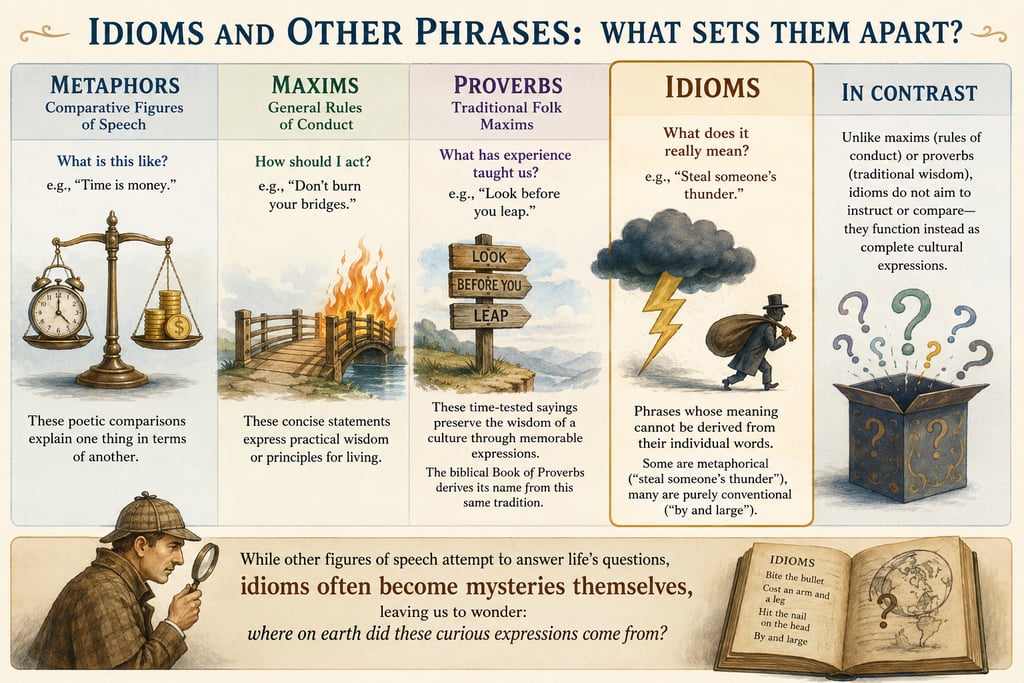
It is easy to confuse idioms with other figures of speech. Here is how they stand apart:
Metaphors (Comparative Figures of Speech): These poetic comparisons explain one thing in terms of another. They answer the question: What is this like? (e.g., "Time is money.")
Maxims (General Rules of Conduct): These concise statements express practical wisdom or principles for living. They answer the question: How should I act? (e.g., "Don't burn your bridges.")
Proverbs (Traditional Folk Maxims): These time-tested sayings preserve the wisdom of a culture through memorable expressions. They answer the question: What has experience taught us? (e.g., "Look before you leap.") The biblical Book of Proverbs derives its name from this same tradition.
Idioms, by contrast, are phrases whose meaning cannot be derived from their individual words. While some are indeed metaphorical (e.g., “steal someone’s thunder”), many others are purely conventional, with their meanings established through usage alone (e.g., “by and large”). Unlike maxims, which express rules of conduct, or proverbs, which preserve traditional wisdom, idioms do not aim to instruct or compare—they function instead as complete cultural expressions. While other figures of speech attempt to answer life's questions, idioms often become mysteries themselves, leaving us to wonder: where on earth did these curious expressions come from?
Because the magic of an idiom lies in its exact phrasing, you usually cannot swap words in and out. For example, you must say "break a leg," not "break an arm," to wish someone good luck; or if you want to say you heard a rumor directly from the source, you say you heard it "straight from the horse's mouth," not "straight from the pony's mouth." Changing even one word often alters or weakens the intended meaning of the expression. Additionally, because idioms are often culturally specific, it's generally avoided to use them in formal academic or professional writing, which makes them somewhat difficult to comprehend to novice English language learners.
Whether you are trying to master a new language or just aiming to add some personality to your everyday speech, idioms are powerful and fun tools that make communication colorful.
Don't get left in the dark!
Bookmark our Idioms page to stay in the loop—we’re exploring the strange histories behind these curious expressions we use commonly without a second thought.












Most idioms originate as literal phrases that gradually evolve into figurative expressions over time.
Under the weather: This idiom likely originated from maritime history. When sailors felt seasick or ill during a storm, they would go below deck to get away from literal "bad weather," eventually becoming an idiom for feeling sick.
Turn a blind eye: This phrase comes from British naval history. During the Battle of Copenhagen, Admiral Horatio Nelson was ordered to withdraw. He intentionally placed his spyglass to his blind eye and claimed he couldn't see the signal, leading his fleet to victory anyway.
Bury the hatchet: This phrase comes from a literal Native American peace custom. When tribes settled a conflict, chiefs physically buried their weapons deep underground to show the war was over.
Where Do They Come From?
Mapping the Mystery: Core Categories
The Hidden Irony of Certain Idioms
Using Idioms Effectively
Explore More with SHIFT

Contact
Questions or feedback? Reach out.
shift@searchinghistoryforthem.com
AI/ECO: This website uses AI for good.
Our host uses 100% renewable-powered servers and advanced cooling systems.