

THE SHATTERED SKIES
Gnosticism, the New Age Matrix, and the Crucible of the Soul
SHIFT
6/9/202646 min read
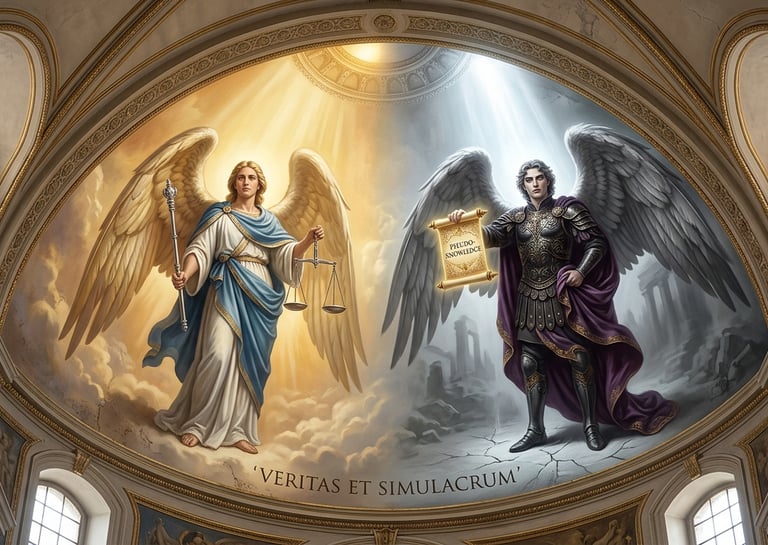
Note from the Editor
Prior to conducting the research required to create this article, I had never heard of Sophia, the Demiurge, or the strange, dark machinations of the ancient Gnostic machine.
To say that discovering this hidden history was a shock would be an understatement. It may shift the way you look at the nature of our reality, and the media we consume.
Because of that, I ask only one thing as you read through: please keep an open mind. What follows is what I believe to be a comprehensive introduction to a topic that has been running beneath the surface of human history for thousands of years.
Buckle up, stay curious, and remember, the truth is often far wilder than fiction.
—SHIFT
The Architecture of the Cage: The 12 Archons
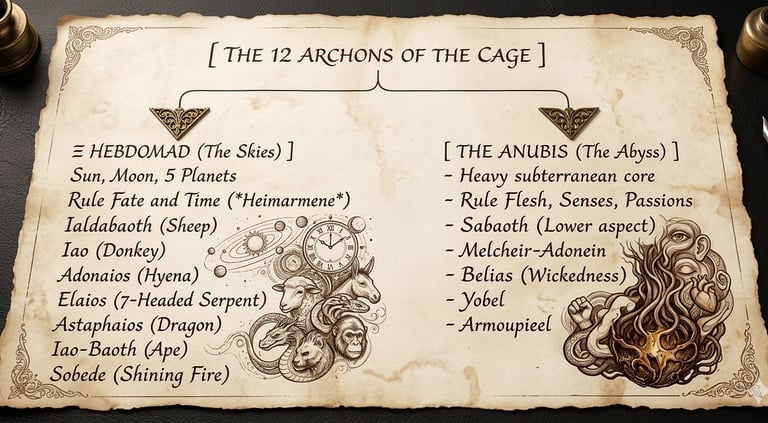
With his stolen light and the raw, unformed material of chaos at his disposal, Yaldabaoth set out to construct a physical universe that would mirror his internal delusion. He did not create out of a sense of divine love or generosity; he engineered out of a desire for absolute control, building a multi-layered matrix designed to keep human spiritual consciousness small, dependent, and perpetually locked inside a low-vibrational trap. To run this celestial prison system, the Demiurge generated an executive cabinet of 12 primary Archons (archōnes, meaning "magistrates" or "rulers"), splitting them strategically between the visible skies and the subterranean depths.
The Hebdomad: The Seven Skies of Fate
The first seven Archons were stationed within the upper celestial spheres, forming a ruling council known as The Hebdomad. These seven corresponded directly to the sun, the moon, and the five planets known to the ancient world. Yaldabaoth assigned each of these planetary wardens a grotesque, theriomorphic (beast-faced) appearance to reflect their aggressive, predatory nature, giving them names that mocked the true divine realm:
Athoth – Stationed at the lowest sky closest to the earth, possessing the face of a sheep.
Eloaiou – Governing the second sphere, possessing the face of a donkey.
Astaphaios – Ruling the third sky, possessing the face of a hyena.
Yao – Command over the fourth sphere, possessing the face of a seven-headed serpent.
Sabaoth – Guarding the fifth sky, possessing the face of a dragon.
Adonin – Overseeing the sixth sphere, possessing the face of an ape.
Sabbede – Enforcing the seventh and highest sky, possessing a face of shining fire.
The function of the Hebdomad was to construct and maintain the rigid grid of astrological fate. The Gnostics asserted that the movements of the planets and the cycles of time were not beautiful displays of cosmic order, but the rotating gears of a giant machine designed to lock human destiny into predictable, unchangeable loops. Every hour, every day, and every life-event was micro-managed by these seven beast-faced governors, stripping humanity of its spiritual sovereignty and binding the soul to the laws of physical cause and effect.
The Five Rulers of the Abyss
While the planetary Hebdomad looked outward and upward to block the gates of the night sky, the remaining five Archons were anchored at the heavy, subterranean core of the matrix—the Abyss. These five were named Sabaoth (a lower, earth-bound aspect of the dragon), Melcheir-Adonein, Leekaphan, Yobel, and Armoupieel.
Where the seven planetary rulers managed time and destiny, these five abyssal rulers governed the heavy, chemical laws of physical matter and biological decay. They were the architects of the material trap: anchoring the five physical senses (sight, hearing, touch, taste, and smell) specifically to convince the human mind that physical matter is the only reality that exists.
They also engineered the five fleshly passions—fear, grief, desire, anger, and material pleasure—to cloud the mind, ensuring that the human spirit remained emotionally volatile and hyper-focused on earthly survival.
Furthermore, this abyssal layer functioned as the cosmic recycling center, or Hades, where the memories of unawakened souls were systematically wiped before their spirits were forcefully reincarnated back down into new physical containers, resetting the trap over and over again.
The Microcosm Grid: The 365 Lower Angels
To ensure that the cage was absolutely foolproof, this massive cosmic bureaucracy was duplicated down into the microcosm of the human anatomy. The Apocryphon of John goes into meticulous, bone-by-bone detail, explaining that Yaldabaoth created a secondary army of 365 lower angels, assigning exactly one angel to construct and govern every single individual bone, nerve, muscle, and organ of the human body.
The physical human body was literally a composite biological prison grid. Every joint was bound by a specific lower frequency; every nerve was wired by a planetary agent. The biological container was engineered to behave as a heavy dampening field, lowering the vibration of the divine soul and inducing a state of deep collective amnesia.
The matrix was complete, and the walls were locked. Believing his structural prison was airtight, Yaldabaoth sat upon his throne of chaos and uttered his infamous, delusional proclamation: "I am a jealous God, and there is no other God beside me." He genuinely believed his own claim because his blindness prevented him from seeing that his whole universe was merely a tiny, darkened drop of condensation hanging off the outer rim of the infinite Pleroma.
The Celestial Clockwork and the Literary Forgery
Patient Zero: The Pride of the Magus
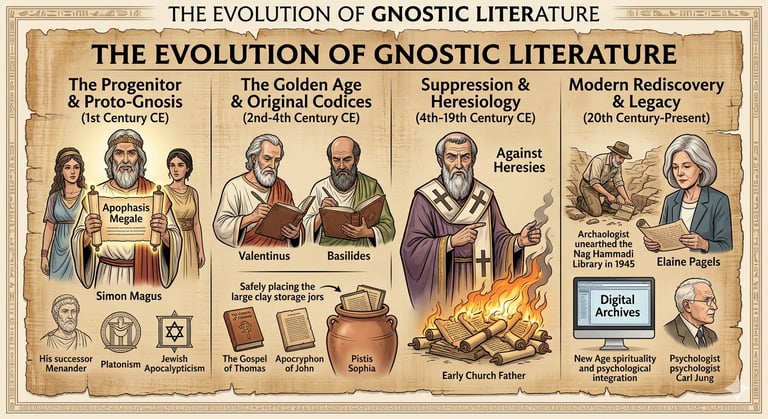
To trace the architecture of the cosmic cage back to its definitive earthly origin, we must first look past the anonymous second-century text blocks and identify the singular historical figure whom early Church chronicles explicitly label as the "Father of Gnosticism": Simon Magus.
Long before the Nag Hammadi scrolls were hidden in Egypt, Simon was a prominent Samaritan sorcerer who heavily captivated the local population with his supernatural arts, loudly boasting that he was "someone great" while the masses revered him as "the Great Power of God".
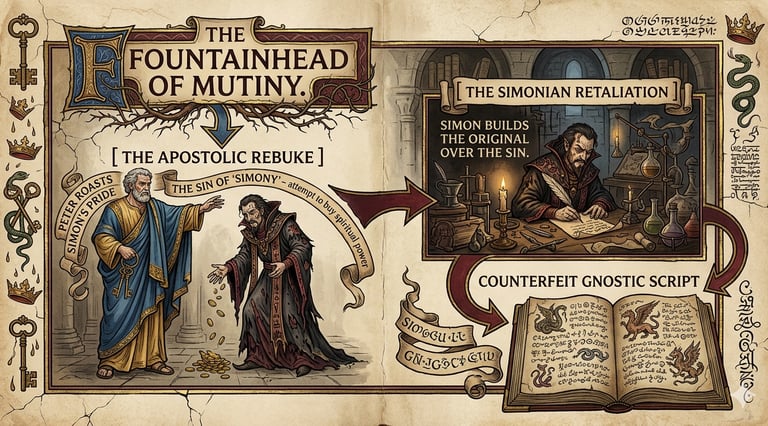
As recorded in the canonical account of Acts 8:9–24, Simon's trajectory shifted when he witnessed the genuine, unvarnished miracles performed by the Apostles. Recognizing a spiritual frequency vastly superior to his own illusionary magic, he professed conversion and was baptized. However, his underlying vanity quickly unmasked itself. When he watched the Apostles Peter and John lay hands on believers to impart the Holy Spirit, Simon pulled out a heavy bag of currency and aggressively tried to purchase their spiritual authority.
The resulting apostolic rebuke was absolute and blistering. Peter flatly roasted his pride, declaring that his money could perish with him because he believed the free gift of the Almighty could be commodified—a historic confrontation so infamous that the sin of buying or selling spiritual positions is named "Simony" after him to this day.
Introduction: The Illusion of Brokenness
The Baseline Sensation
In moments of profound grief, the human mind struggles to reconcile its physical surroundings. We look out at the world, seeing breathtaking natural beauty mismatched against a background of terminal disease, starvation, earthquakes, and emotional agony. This stark contrast prompts the query: Why does the system operate this way? Many realize that we are spiritual beings of infinite capacity, yet we find ourselves housed in fragile, easily damaged containers of flesh and bone. Subjected to a physical environment governed by cold limitations, and mortality, we are at times left feeling like exiles in a reality that was meant to be at peace.
The Great Clash: Why Gnosticism Was Shunned and Scattered
To the early Christian Church, this intricate, cinematic cosmology was not seen as a beautiful alternative path to mystery; it was recognized as a dangerous, blasphemous, and highly coordinated assault on the core of the Gospel. As a result, a massive theological and institutional war erupted across the Mediterranean world during the second and third centuries, led by "heresy-hunting" Church Fathers like St. Irenaeus of Lyons (Against Heresies, c. 180 AD), Tertullian, and Hippolytus of Rome.
The orthodox Christian Church did not push Gnosticism to the margins out of a petty desire for political control; they systematically shunned and scattered these secret societies because the Gnostic worldview shattered the foundational truths of the apostolic faith across three major theological fronts:
1. The Slander of the Father
For Irenaeus and his contemporaries, the ultimate blasphemy of Gnosticism was its characterization of the biblical Creator God as a blind, monstrous, slavering beast. The God who carved out the heavens, formed humanity in love, and delivered Israel from bondage was branded by Gnostics as an ignorant accident born of a celestial defect. In Against Heresies, Book IV, Irenaeus explicitly warned that these teachings were directly inspired by adversarial spiritual forces to make the true Source of life look like a tyrant. By painting the Author of life as a monster, the Gnostics pulled off a masterstroke of spiritual sabotage, ensuring that a searching soul would actively flee from the only God capable of saving them.
2. The Sin of Intellectual Elitism
Mainstream Christianity revolutionized the ancient world because it preached that salvation was a universal, free gift of grace accessible to all humanity through humble faith—regardless of an individual’s intellect, wealth, gender, or social status. Gnosticism, by contrast, restricted salvation to a small, elite inner circle of spiritual people (pneumatics) who possessed the specific intellect to master complex star maps, decode esoteric metaphors, and memorize secret passphrases. In Against Heresies, Book III, Irenaeus fiercely attacked this profound spiritual vanity, noting that Gnostics were bloated with pride, believing they were naturally superior even to the Apostles who walked with Christ. It turned faith into an intellectual achievement for an elite club, slamming the door on the simple and the humble.
3. The Deception of Docetism (Denying the Flesh)
Because Gnostics believed that material matter was inherently corrupt and created by Yaldabaoth, they fiercely rejected the orthodox doctrine of the Incarnation—the belief that God took on a real, physical human body of flesh. Instead, they championed Docetism (from the Greek dokein, meaning "to seem"), claiming that Jesus's physical body was merely an illusion, a spiritual phantom that left no footprints.
The early Church recognized this as a total deletion of the Gospel. If Christ did not possess real human flesh, then his suffering on the cross was a theatrical trick, his physical resurrection was a lie, and the material world was completely abandoned to darkness. The orthodox Church pointed directly to the New Testament warnings against those who deny Christ coming in the flesh, classifying the Gnostic separation of Jesus from physical reality as a dangerous deception (1 John 4:3).
The Earthen Time Capsule of Nag Hammadi
For centuries, Gnostic sects operated as a fragmented, fluid network of competing secret societies. Because they emphasized private, individualized enlightenment over public community, they failed to build a centralized institution. The orthodox Church, meanwhile, formed a tightly organized, unified global network of mutual support and shared doctrine.
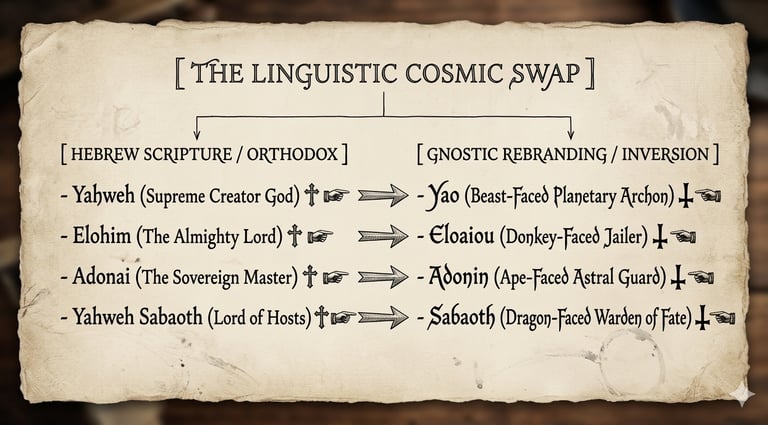
The primary mechanism of this subversion was the strategic hijacking of holy titles. In the Hebrew Scriptures, names like Yahweh, Elohim, Adonai, and Sabaoth are sacred designations belonging to the single, sovereign, omnipotent Creator of the universe. The Gnostics shattered this divine unity. In the anonymous, second-century text The Apocryphon of John, these holy titles are stripped of their sublime status and assigned directly to the grotesque, beast-faced Archons:
Yao is a direct corruption of Yahweh.
Eloaiou is a mutation of Elohim.
Adonin is torn from Adonai.
SABAOTH is stolen from the title Yahweh Sabaoth ("Lord of Hosts" or Lord of Heavenly Armies).
By characterizing these entities by a predatory therianthropy—possessing the roaring, hybrid faces of sheep, donkeys, hyenas, and dragons—the Gnostics pulled off a staggering theological inversion.
They argued that conventional, exoteric religion was an elaborate control grid. According to this worldview, when an orthodox believer offered prayers, built temples, obeyed moral codes, or offered sacrifices to the "Lord of Hosts," their spiritual energy was completely intercepted. It never bypassed the planetary spheres; instead, it directly fed the ego and power of a lower, beast-formed Archon who demanded fear, blood, and absolute submission to keep his artificial simulation running.
The Downgrading of the Archangels
This systematic re-branding did not stop with the names of God; it extended deep into traditional angelology. In classical Judaism and emerging orthodox Christianity, the Archangels—chief among them Michael, Gabriel, Raphael, and Uriel—are viewed as radiant, holy protectors. They are divine ministers of grace who guard the faithful and safely carry the souls of the deceased up to the heavenly presence.
An ancient text, discovered in 1773 and dating to roughly the 3rd to 4th centuries, the Pistis Sophia is regarded as one of the most extensive surviving Gnostic gospels. Written in Coptic, the text is framed as a secret, post-resurrection dialogue across eleven years between a transfigured Jesus and his disciples—most notably Mary Magdalene. However, it is important to bear in mind that mainstream biblical scholars emphasize that the text is not a historically authentic gospel written by eyewitnesses. Instead, academia classifies it as a late, non-canonical, pseudepigraphal anthology composed centuries after the life of Jesus.
According to the Pistis Sophia, the radiant defender archangels are stripped of their holy status and recast as cosmic enforcement officers serving the interests of the Demiurge. Instead of protecting humanity, Michael and Gabriel are described as celestial border patrol agents stationed at the planetary checkpoints. Their job within the Gnostic framework is to manage the heavy, complex machinery of the lower heavens: tracking the movements of souls, administering the waters of forgetfulness, and forcefully guiding human "divine sparks" back down into new physical bodies. To the Gnostic, the traditional "heavenly host" was actually an organized administrative network of wardens designed to ensure that no inmate ever escaped the matrix.
The Garden of Eden Sabotage
The ultimate expression of this spiritual inversion is found in the Gnostic retelling of the Garden of Eden, detailed with cinematic detail in The Hypostasis of the Archons (The Reality of the Rulers). In this text, the entire Genesis narrative is recast as a psychological warfare campaign waged by the Archons against the first humans.
When Yaldabaoth and his rulers form Adam and Eve, they quickly realize that the human creatures contain a luminous, vibrant spark of divine light passed down from Sophia—a power far greater than anything the Archons possess. Envious of this light, the Archons attempt to trap human consciousness in a permanent vegetative state. They place them in a garden and issue a strict decree forbidding them from eating from the Tree of Knowledge (Gnosis). In traditional scripture, this prohibition is a holy boundary meant to protect humanity from sin and death. In The Hypostasis of the Archons, however, the command is a malicious embargo on truth. The Archons want humans to remain spiritually asleep, treating their material jailers as their ultimate gods.
Because of this, the roles of the Eden drama are completely flipped:
The Creator God who walks in the garden is unmasked as the blind tyrant Samael, desperately trying to keep his creations small, dependent, and unaware of reality.
The Serpent is elevated to a heroic, enlightened savior. The serpent is portrayed as an instrument of divine wisdom (Sophia), sent from the higher realms to infiltrate the garden.
The serpent does not tempt humanity to fall into sin; rather, it instructs Adam and Eve to eat from the tree to break their mental programming. Upon eating the fruit, their spiritual eyes are opened. They experience gnosis, realizing that their true origin lies in the uncreated light of the infinite Monad, far above the beast-faced rulers who claimed to create them. With one bite, humanity discovers that the masters of the world are merely lesser, flawed entities—and the Archons' absolute monopoly on truth is shattered forever.
Salvation required a clandestine spiritual military operation; a covert infiltration of the cosmic prison grid from within.
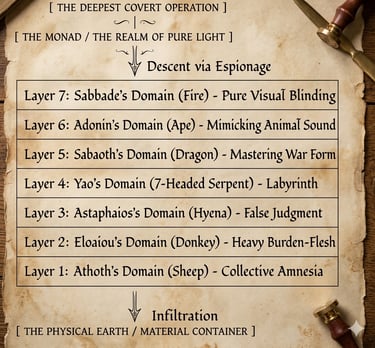
This structural stealth mission forms the core of Gnostic Christology, detailed extensively in the Apocryphon of John, the Gospel of Judas, and the multi-volume Pistis Sophia. Christ is understood not as a human sacrifice meant to appease a wrathful creator god, but as an elevated, luminous Aeon emerging directly from the heights of the Pleroma. To bypass the border security of the Hebdomad, the Savior had to execute a campaign of cosmic espionage, systematically manipulating his frequency, his language, and his appearance as he descended through each of the seven celestial layers of heaven.
The Infiltration of the Seven Heavens
The first and highest gateway of the prison grid is the Seventh Heaven, the outer rim of the material matrix bordering the dark void. This realm is governed by the Archon Sabbede, whose face is a roaring manifestation of shining fire. Sabbede’s domain acts as the primary defense perimeter, radiating an intense, deceptive brilliance designed to look like the true divine light to any soul attempting to look upward. To pass this gate, Christ had to compress his infinite, uncreated light into a localized, fiery frequency that perfectly matched Sabbede’s harsh vibration. He took on the appearance of a celestial entity of pure flame, mimicking the protocol of the high angels of the seventh sky. Because his frequency blended seamlessly with the scorching atmosphere, Sabbede accepted him as a native inhabitant of the highest boundary, allowing the light to slip past the outer wall.
Descending into the Sixth Heaven, the Savior entered the territory of Adonin, the Archon who possesses the face of an ape. Adonin’s realm is the seat of mimicry, mockery, and the distortion of divine speech. Here, the holy frequencies of the Pleroma are echoed backward into the universe as twisted, mechanical vibrations that confuse the human spirit. To infiltrate this layer, Christ altered his spiritual voice, shifting his sound into the specialized, lower dialects of Adonin’s administrative court. He cloaked his pristine thoughts behind the animalistic, repetitive cadences used by the guardians of the sixth sky. By perfectly mirroring the behaviors and language of the mimicking ape-god, Christ was cataloged as a loyal servant of the sixth domain and granted free passage downward.
The Fifth Heaven presented a highly dangerous barrier, ruled by Sabaoth, the dragon-faced Archon of cosmic armies, wrath, and judgment. Sabaoth’s realm is a fortress of military order, characterized by intense spiritual friction and defensive walls designed to vaporize any unauthorized spiritual entity. Here, the laws of cosmic warfare and structural division are enforced. To survive this descent, Christ transformed his appearance into a manifestation of supreme authority, cloaking his peaceful essence in the form of a high cosmic commander of the dragon's host. He matched the intense, rigid vibration of Sabaoth’s guard, displaying the precise insignia of power and structural keys required to navigate the fortress. Deceived by this perfect display of military rank, the dragon-faced warden ordered his armies to stand down, opening the gates of the fifth sky to his own hidden conqueror.
The Savior then passed into the Fourth Heaven, a complex labyrinthine territory managed by Yao, the seven-headed serpent. Yao’s domain is the central hub of astrological fate and the distribution of the Zodiac’s strings. The seven heads of Yao look in all directions simultaneously, weaving the web of destiny that locks human lives into predictable, unchangeable loops of time. To infiltrate this intricate knot, Christ split his localized manifestation into multi-layered frequencies, matching the gaze of all seven serpent heads at once. He synchronized his descent with the movement of the planetary gears, making his presence appear as a natural, expected alignment of the stars. Completely blinded by their own mathematical complexity, Yao’s seven heads recorded the Savior’s movement as a mere routine fluctuation of the cosmic clock, allowing the light to slide undetected through the center of the web.
The Third Heaven is governed by Astaphaios, the hyena-faced Archon of false judgment, cosmic bureaucracy, and spiritual trickery. Astaphaios’s realm operates as a massive court of laws, where souls are interrogated, weighed against false balances, and trapped by their own guilt and fear. The atmosphere here is heavy with accusation. To pass this tribunal, Christ took on the posture of a quiet, unassuming legal entity, wrapping his uncreated glory in a cloak of absolute humility that was invisible to the predatory nature of the hyena-god. Because Astaphaios only searches for entities he can terrorize or exploit through guilt, Christ’s flawless, accusation-free vibration bypassed the court's scanners entirely. The hyena-faced judge found nothing to hook into, dismissing the disguised Savior as an insignificant phantom passing through the lower courts.
Entering the Second Heaven, the Savior encountered the domain of Eloaiou, the donkey-faced Archon of labor, burden, and the crystallization of physical matter. Eloaiou’s sky is where the light of the spirit is systematically weighed down and prepared for physical density; it is the atmospheric crucible where the subtle energies of the soul are packed into heavy astral matrices. To endure this layer, Christ allowed his frequency to become exceptionally heavy, mimicking the burdened, plodding vibration of the donkey-god’s laborers. He took on the spiritual weight of a servant bound to the material plow, masking his sovereignty under an appearance of total submission to the rules of physical gravity. Deceived by this display of apparent servitude, Eloaiou stamped the Savior’s passport, viewing him merely as another piece of cargo destined for the earthly surface.
Finally, Christ reached the First Heaven, the lowest sky directly bordering our atmosphere, ruled by Athoth, the sheep-faced Archon of collective amnesia, blind compliance, and herd consciousness. Athoth’s domain acts as a massive dampening field, radiating waves of deep spiritual sleep and forgetfulness over the earth to ensure that humans remain oblivious to their divine spark. To slip through this final net, Christ masked his blinding consciousness behind a vibration of deep stillness, mimicking the quiet, unawakened frequency of the human collective. He appeared as just another silent, slumbering drop of light descending into the fog of matter. Athoth’s scanning nets swept right over him, detecting nothing but the passive, sheep-like frequency of his own kingdom.
With this final gate bypassed, the covert operation was complete. The supreme light of the Monad had successfully penetrated all seven layers of the planetary security grid, completely outsmarting the twelve Archons, and anchored itself safely within a human container on the physical plane.
The Battering Ram of Light
According to Gnostics, the purpose of Christ's earthly life and teaching was to plant the seeds of gnosis in an inner circle of human souls, but the ultimate climax of his mission occurred during his post-resurrection ascent. Having successfully awakened the divine spark within his core disciples, Christ shed his earthly disguise and rose back up through the seven planetary heavens—not in secret, but in his unmitigated, blinding divine splendor.
The Pistis Sophia records the absolute cosmic panic, terror, and pandemonium this open ascent caused among the 12 Archons and their lower bureaucracies:
"And all the rulers and all those who are in the cosmic spheres became distracted because of the great light which was upon me... And they looked at my shining garment and saw the mystery of their own destruction. And they rebelled, fighting against the light. But I took away a third of their power, so that they could no longer direct the paths of the stars and the fate of human souls as they had done before."
By ascending through the planetary spheres as a raw, unveiled beam of uncreated light, Christ acted as a spiritual battering ram. He shattered the astral seals, broke the structural determinism of astrological fate, and carved a permanent tear right through the matrix. He left behind an open, unlocked pathway through the heavens, ensuring that when an awakened soul leaves its physical container at death, it can follow his path back to the Monad without being captured, interrogated, or recycled.
The Escape Codes of the Soul
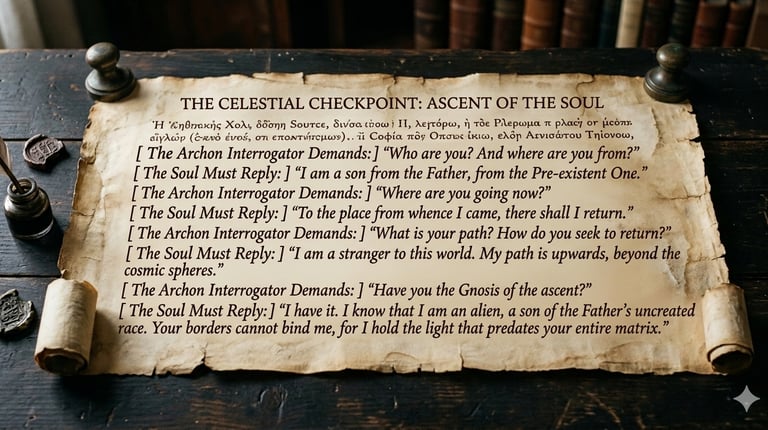
Gnostics believed that Christ did not just carve this path for himself; he remained on Earth for years after his resurrection to pass down the exact navigation instructions required for humans to execute this same escape. In The First Apocalypse of James, yet another text found in the Nag Hammadi discovery of 1945 and, again, one scholars do not believe was actually written by its attributed author, Jesus explicitly acts as a spiritual tactical instructor, training James on how to handle the terrifying interrogation process conducted by the toll-collecting Archon judges at the celestial borders:
Jesus tells James:
"When you fall into their hands, an Archon will say to you, 'Who are you, and where are you from?' You must reply to him, 'I am a son from the Father, and I am from the Pre-existent One.' ... And when he says to you, 'Where are you going?', you shall say to him, 'To the place from whence I came, to that place shall I return.' And if he says, 'How will you pass?', you shall say, 'By the power of the Pre-existent One, which shatters all authority.'"
These secret passphrases and handshakes were treated by Gnostics as a form of cosmic counter-technology. They were the essential software codes required to outwit the 12 Archons, disable the security locks of the 7 skies, and slip past the planetary grid into the eternal light of the Father.















The Modern Blueprint: New Age Propaganda as the New Matrix
Though the ancient text scrolls were packed into earthenware jars and buried deep within the Egyptian cliffs around 367 AD, the core philosophy of Gnosticism was never truly eradicated. It merely went into a state of structural dormancy, waiting for a cultural environment that would allow its radical ideas to resurface. When those jars were finally unearthed in 1945, the texts did not simply remain obscure museum artifacts; they were rapidly seized upon by influential 20th-century thinkers who rebranded their contents for a modern audience.
The Intellectual Rebranding: Jung and Pagels
The first major catalyst was the Swiss psychiatrist Carl Jung, whose institute covertly purchased one of the primary Nag Hammadi volumes (now known as The Jung Codex). Jung stripped the texts of their ancient religious context and translated them into secular psychology. He argued that the blind, arrogant creator Yaldabaoth was simply a perfect metaphor for the human Ego, and that Gnosis was just an early form of therapy—a process of looking inward to realize one's own internal divinity.
Shortly after, Princeton historian Elaine Pagels published The Gnostic Gospels (1979), humanizing the ancient heretics for the secular public. Pagels asked deep questions based on these books, bringing immense focus to the Divine Feminine within the literature. She highlighted how texts like the Pistis Sophia explicitly depicted Mary Magdalene asking over half of the complex spiritual questions—intellectually eclipsing the male apostles like Peter. Pagels argued that the mainstream Church had suppressed these alternative histories primarily to protect an all-male institutional hierarchy, effectively romanticizing the Gnostics as misunderstood freedom fighters.
Together, Jung's psychological interpretation and Pagels' sociopolitical focus completely flipped the cultural narrative. They caused a highly educated modern public to once again ponder the validity of the Gnostic premises. By celebrating the texts as tools for self-discovery and anti-institutional liberation, they inadvertently built the exact launchpad for the contemporary New Age revival.
In the late 20th and early 21st centuries, that revival arrived in full force. Today, the ancient Gnostic mythos has undergone a highly sophisticated digital re-branding campaign, emerging as the dominant engine behind modern New Age spirituality and technological Simulation Theory. When modern alternative researchers, futurists, and New Age influencers describe our physical world as a "low-vibrational hologram," a "virtual simulation," or a "3D Matrix," they are not inventing a new philosophy; they are translating the Apocryphon of John into the language of computer science and digital technology.The structural architecture remains identical:
The Material Universe is rebranded as the 3D Matrix—an artificial, holographic prison program designed to keep human consciousness limited.
Yaldabaoth, the Demiurge, is recast as a Rogue AI, a malicious programmer, or "The Architect" who built the simulated reality to exploit human energy.
The 12 Archons are reimagined as "Negative Extraterrestrials," "Archontic Entities," or "Anunnaki Control Grids" who utilize the solar system's planetary energies and moon-matrices to beam low-frequency waves into the human brain, keeping humanity locked in a state of collective amnesia.
Gnosis is repackaged for the modern cinema and digital age as "Taking the Red Pill," "unplugging from the system," or executing a "vibrational shift into the 5D Earth."
The Propaganda of Self-Deification
Critics, orthodox theologians, and psychological analysts argue that this modern manifestation deserves the title of "propaganda" because it uses a deceptive mechanism to manipulate human vanity. The most potent tool in this system is the modern New Age concept of "Manifestation" and "The Law of Attraction."
In books like The Secret and across endless digital manifestation platforms, the seeker is told a foundational premise: You are the absolute creator of your own reality. If you change your thoughts, your mind can manifest wealth, health, and alter the physical universe to serve your personal desires.
To a critical theological eye, this is the ultimate expression of the Gnostic inversion. It completely deposes an external, sovereign, holy Creator God and replaces Him with the human ego. The external God of scripture—who commands holiness, humility, and repentance—is erased and replaced by an abstract, impersonal, cosmic vending machine known simply as "The Universe" or "Source Energy." This "Universe" possesses no moral boundaries; it exists solely to mirror and validate the individual’s personal intentions once they tap into their own inner divinity.
The Weaponization of the "Awakened"
Furthermore, modern New Age propaganda mirrors ancient Gnosticism by weaponizing intellectual pride. Just as ancient Gnostics divided humanity into the Pneumatics (the spiritually elite who possessed gnosis) and the Psychics/Hylics (ordinary believers and materialists who were blind), modern New Age circles construct an aggressive social binary.
The modern seeker is constantly bombarded with the question: "Are you awake, or are you a sheep?" This dynamic feeds a profound form of spiritual vanity. It convinces the individual that because they understand the mechanics of the "Matrix," look at alternative timelines, or meditate on 5D frequencies, they are inherently superior to the ordinary, hardworking people who sit in traditional pews or navigate everyday life.
By eliminating the concept of personal sin and replacing it with the concept of "low vibration," New Age propaganda removes the keys of humility, accountability, and repentance. It creates a closed psychological loop where the human mind behaves exactly like Yaldabaoth inside his cloud: looking inward, worshiping its own reflection, and declaring itself the ultimate source of reality, completely blind to any authority greater than itself.
The Cinematic Gnosis: Classic Media as the Astral Mirror
The most potent way a philosophy survives institutional suppression is by migrating out of theological treatises and embedding itself into the cultural subconscious through art, folklore, and performance. The tenets of Gnosticism, the realization that the world is a rigged simulation, that the authority figures we see are lesser impostors, and that we must navigate a maze to free our divine spark—have been deeply cloaked within mainstream media for over a century.
For the modern seeker, classic literature and early cinema serve as an astral mirror, reflecting the exact same cosmic architecture hidden inside the Nag Hammadi scrolls. By decoding these foundational, public domain works, we can see exactly how the ancient matrix has been presented to the public under the guise of entertainment:
The Wizard of Oz (L. Frank Baum, 1900): The ultimate Gnostic allegory of the soul's journey. Dorothy represents the divine spark dropped into a colorful, confusing simulation (Oz) after a violent cosmic disruption (the tornado). To escape, she must follow a predetermined path (the Yellow Brick Road) and confront the ruler of the realm. Ultimately, the "Great and Powerful Oz" is unmasked as a fraud behind a curtain—the perfect cinematic archetype of Yaldabaoth, the Demiurge, a lesser, fragile coordinator playing the role of a supreme god.
Metropolis (Fritz Lang, 1927): This silent sci-fi masterpiece lays out the physical, material prison grid with stunning visual accuracy. The subterranean workers are slaves to the massive machines of the lower world (The Abyss), while the wealthy live in a superficial paradise above. The creation of the predatory, metallic robot-double of Maria perfectly mirrors the Archons creating the false, physical clone of Eve in The Hypostasis of the Archons to deceive and control human consciousness.
Alice in Wonderland (Lewis Carroll, 1865): Alice represents the human spirit falling down a cosmic rabbit hole into a chaotic, nonsensical lower matrix (Wonderland) governed by arbitrary, tyrannical laws and volatile, beast-like rulers (The Queen of Hearts and her card soldiers). To survive, Alice must maintain her memory and identity, outsmarting a labyrinth of linguistic trickery that mirrors the soul navigating past the 12 Archons at the planetary borders.
Faust (J.W. von Goethe, 1808 / F.W. Murnau, 1926): The classic tale of a brilliant scholar who makes a pact with Mephistopheles (the fallen agent). Faust represents the ultimate danger of pursuing Gnosis without humility. By attempting to outsmart human limitations and master the physical simulation through forbidden, occult calculations, Faust falls directly into the intellectual trap of spiritual vanity, mirroring the original pride that fractured the Pleroma.
The Phantom of the Opera (Gaston Leroux, 1910 / Lon Chaney, 1925): The Phantom (Erik) is a tragic, disfigured master of illusions who lives in the subterranean dark depths beneath the Opera House. He acts as a lesser, hidden creator—shaping the careers of the singers, controlling the architectural matrix of the building through secret trapdoors, and demanding total obedience while cloaked in a mask. He represents the hidden, monstrous architect of the lower plane, holding the soul (Christine) hostage through the manipulation of art and desire.
Carnival of Souls (Herk Harvey, 1962): A haunting, low-budget masterpiece that perfectly illustrates the Gnostic concept of spiritual amnesia and Docetism. Following a drag race accident, Mary Henry wanders through a cold, disconnected world, pursued by pale, phantom-like entities. She believes she is a living, physical human navigating everyday life, only to realize at the end that her physical presence was an illusion—she has been a spirit trapped in an atmospheric liminal matrix all along, unable to cross over because she lacks awareness of her true state.
The Modern Evolution: From Film to Virtual Reality
These classic public domain archetypes paved the way for the modern blockbusters we see today. The fraudulent wizard behind the curtain in Oz and the mechanical deception of Metropolis laid the direct conceptual foundation for The Matrix (1999), where humanity is literally harvested as batteries by an AI architect, and The Truman Show (1998), where a man discovers his entire life is a controlled television set directed by a creator named Christof who watches him from a fake sky.
Whether expressed through the silent, haunting imagery of 1920s cinema or the high-tech visual effects of modern Hollywood, the underlying script has remained completely unchanged for two thousand years. The media we consume continues to act as a highly organized delivery system for the ancient Gnostic worldview, constantly whispering to the subconscious mind that our reality is a counterfeit, our leaders are frauds, and the keys to our freedom are hidden in plain sight.
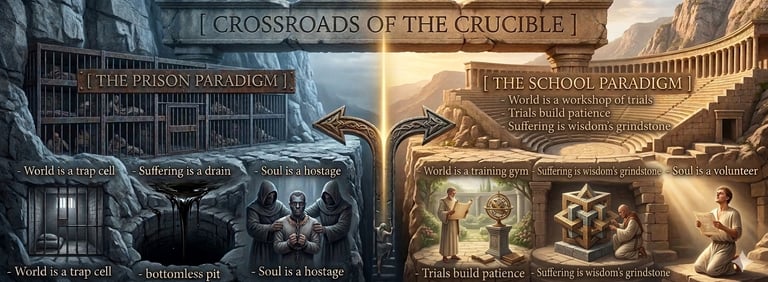
Life Is A Prison or A Training Ground?
The Crucible of the Soul
The entire structural framework of both ancient Gnosticism and modern New Age propaganda relies on a singular, foundational premise: the physical world is an unfair, broken environment, therefore its Creator must be a monster or an ignorant tyrant. This philosophy looks at the existence of human tragedy, disease, and sudden accidents and weaponizes that agony to argue that no loving, supreme God could ever be the author of such an ill fate. However, when we step back from this cosmic rebellion and examine the broader tradition of classical mysticism, alternative paradigms, and even the counter-arguments of the early Church, this Gnostic premise is thrown entirely on its head.
The fundamental flaw of the Gnostic worldview is that it treats human suffering as entirely senseless, parasitic cruelty. To the Gnostic, a terminal illness or a broken heart has zero evolutionary value; it is merely an energy-drain orchestrated by the Archons to keep your vibration suppressed. But a profound alternative exists across mystical schools—one that reframes the material universe not as a prison cell, but as a highly specialized, rigorous school. In this model, physical reality is a spiritual gymnasium, and hardship is the necessary resistance-and-pulley system required to catalyze spiritual evolution. Just as a physical muscle cannot grow or prove its strength without meeting the resistance of a heavy weight, a human soul cannot develop or prove the frequencies of absolute faith, unconditional love, and unshakeable trust without being tested against absolute darkness.
This paradigm fundamentally transforms how we view human agency, shifting the soul from a helpless hostage to a fearless volunteer. Gnosticism teaches that we are victims of a cosmic crime—tricked, blindsided, and forcefully crammed into biological containers by lower entities. The school paradigm asserts the exact opposite: that as eternal spiritual beings, our souls actively vied for the opportunity to incarnate onto the earthly plane. Before entering this life, the soul looked down at the challenges, the heartbreaks, and the heavy crucibles of the earthly timeline and eagerly volunteered for the mission, whispering: "Send me into the density. I want to test my spiritual frequency against that darkness to see if my faith can hold true."
It suggests that life is undeniably tough, but our souls actually volunteered for the hardship before birth—eager to strengthen their faith and catalyze their ultimate evolution. This perspective is a paradigm maintained not only by ancient orthodox theologians, but also echoed across modern spiritual and near-death literature, including emergency medicine reflections like Dr. Michael Abrams’s The Evolution Angel, which frame these terrible occurrences as moments where trust and faith are strengthened, not diminished.
Ironically, this alternative mystical perspective aligns perfectly with the foundational theology of the very Church Fathers who fought to scatter the Gnostics in the second century. St. Irenaeus of Lyons explicitly argued that God did not create humanity in a state of static, unchallengeable perfection. Instead, he taught that God created humans as spiritual infants who needed to grow, mature, and voluntarily choose the good through experience and struggle. To the early Church, suffering was not an indication that the Creator was a blind beast, but proof that the material world was a crucible of refinement. They recognized that the true, loving God respects the soul's free will to enter the fire and mature, echoing the words of the Apostle Paul, who famously wrote that suffering is not a cosmic glitch, but a divine catalyst that produces perseverance, perseverance produces character, and character produces a hope that can never be put to shame.
The Ultimate Counter-Theory: Gnosticism as a Fallen Angel Psy-Op
When we piece together these ancient text alignments alongside the blistering critiques of the early Church, a compelling alternative theory emerges. What if Gnosticism was neither a pure revelation of the absolute truth nor merely a human-made philosophical error? What if, instead, Gnosticism was a highly sophisticated, multi-layered psychological warfare campaign engineered by fallen angels to permanently disconnect humanity from the true God?
To comprehend the sheer, calculated malice of this spiritual operation, we must look directly into the dark history and identity of the entities pulling the strings. These are not vague, metaphorical energies; they are literal, ancient celestial mutineers.
Unmasking the Host: Who are the Fallen Angels?
Ancient Jewish and Christian texts describe multiple classes of rebellious spiritual beings operating in opposition to God's purposes.
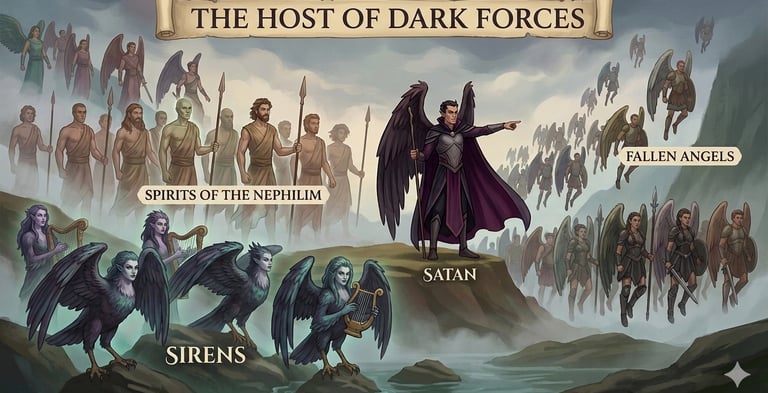
The Book of Enoch recounts the rebellion of the Watchers, a faction of angels who abandoned their heavenly stations, descended upon Mount Hermon, and corrupted humanity through forbidden knowledge. Their union with human women produced the Nephilim, a race of violent giants whose wickedness and bloodshed helped bring about the Flood.
According to Enoch, the Watchers themselves were apprehended and imprisoned beneath the earth until the final judgment, a fate later echoed in the New Testament epistles of Jude and 2 Peter. Their influence, however, did not end with their confinement. Enoch teaches that the spirits of their slain giant offspring remained upon the earth as wandering entities that continue to afflict and deceive mankind. The same tradition records that when the Watchers were seized and bound, the women who had joined themselves to these fallen angels were transformed into winged creatures associated with the ancient legends of sirens, seductive beings said to continue leading humanity astray through temptation, corruption, and forbidden knowledge.
Scripture also describes another kingdom of rebellion led by Satan. Known in Christian tradition as Lucifer, he is portrayed as a once-exalted heavenly being who fell from his lofty station through pride and rebellion against the Almighty. By the time humanity enters the biblical narrative, he is already present in Eden, appearing as the serpent who tempts Eve with the promise of forbidden knowledge and godlike enlightenment. From that moment forward, Satan emerges throughout Scripture as the great deceiver, accuser, and adversary of mankind.
He is depicted not as an isolated rebel, but as the leader of a vast host of principalities, powers, rulers of darkness, and unclean spirits engaged in continual opposition to God's creation. The Book of Revelation describes his primordial fall as a great cosmic upheaval in which a dragon sweeps a third of the stars of heaven to the earth before being identified as Satan himself. The same passage declares that Satan and "his angels" were cast out of heaven together, suggesting that a vast celestial host joined him in his rebellion against the throne of God.
Unlike the Watchers, who were bound beneath the earth until the final judgment, Scripture never explicitly states that these fallen angels were imprisoned alongside their leader. Instead, they likely appear throughout the biblical record as active participants in humanity's spiritual struggles. Many attribute to them the propagation of deception, temptation, false religion, and direct interference in human affairs.
These fallen powers, together with the lord of their host, may have been the original architects of counterfeit spirituality. Throughout the ancient world, civilizations repeatedly encountered entities presenting themselves as gods and demanding worship, sacrifice, ritual devotion, and allegiance. Whether appearing under the names of Baal, Molech, Ishtar, Zeus, Osiris, or countless others, the pattern remains strikingly consistent: humanity is encouraged to direct its reverence away from the Most High and toward lesser spiritual powers masquerading as divine authorities.
Conclusion: The Choice
From the fourth-century Roman Empire to today, we are left with a curated history that is textually fragmented by ancient spiritual wars. Yet, the ultimate irony of this legacy is found not in hidden desert jars, but within the text of the ancient scriptures themselves.
Throughout the Greek New Testament, the literal word GNOSIS appears exactly 29 times. It was not a word that historical spiritual leaders tried to hide; rather, it was a concept actively contextualized as a psychological danger zone. Chief among them was the Apostle Paul, who directly addressed the intellectual elites of the ancient city of Corinth by issuing a profound warning in 1 Corinthians 8:1:
"We know that we all possess knowledge (gnosis). But knowledge (gnosis) puffs up, while love builds up."
The Greek word used for "puffs up" is physioō—which literally means to inflate, bloat, or swell with pride. Ancient wisdom anticipated the exact architectural trap that modern alternative research often falls into: that the single-minded pursuit of secret, elite information naturally feeds human vanity, inflating the ego until a seeker completely loses their humility, blocks out external grace, and becomes separated from a loving relationship with the Creator.



The Great Metaphysical Fork
Throughout human history, this acute awareness of earthly brokenness has forced a massive philosophical divide, splitting human thought into two completely irreconcilable camps. This is the Great Metaphysical Fork, the definitive crossroads where humanity must choose how to interpret its own pain.
The first path is that of Traditional Faith and Classical Theism. Across the major orthodox monotheistic traditions, the physical universe is viewed as a masterpiece of divine design, a fundamentally good creation crafted by a loving, omnipotent Architect. In this paradigm, the pain we experience is not an indictment of the building's layout, but the tragic result of a temporary, historical "Fall." The cosmos is currently broken, fractured by the introduction of rebellion and sin, yet it remains salvageable and sacred. Material reality is the necessary stage where a grand drama of redemption is playing out. Hardship is viewed not as a senseless error, but as a purposeful, refining fire; a harsh but beautifully engineered environment meant to shape, test, and ultimately mature the human soul.
The second path, however, chooses a trajectory of absolute, defiant rebellion. This is the Gnostic Inversion. Emerging out of the chaotic cultural melting pots of the early centuries, the Gnostics looked at the exact same human suffering and arrived at a radically dark conclusion: the physical universe is not a broken masterpiece; it is a meticulously constructed, artificial prison grid. To the Gnostic, the material world is a spiritual maximum-security facility, an intentional trap designed by a flawed, ignorant, or outright malicious creator entity whose sole purpose is to harvest the spiritual energy of humanity. In this worldview, matter itself is inherently corrupt, the physical body is a cage, and the laws of nature are the iron bars keeping our spirits locked in an endless cycle of trauma, distraction, and total amnesia.
The Modern Resurgence
Though ancient history books pretend this dark, rebellious philosophy was completely crushed and buried in the sands of the ancient Near East by the fourth century, the truth is that it never truly died. Gnosticism is an ancient, upside-down cosmic theology that lives on today, brilliantly disguised as modern New Age propaganda and technological Simulation Theory.
Once again, modern seekers are being fed the exact same ancient script, repackaged with a slick, corporate face-lift. The material cage of the ancient world is now called the "3D Matrix" or a "Holographic Simulation." The lower creator god and his rulers have been rebranded as "Rogue AIs" or "Negative Extraterrestrial Control Grids" who beam low-frequency waves into the human brain to keep us asleep. The pursuit of gnosis has been popularized as "Taking the Red Pill," "unplugging from the machine," or executing a "vibrational shift into the 5D Earth." The terminology has shifted from ancient mythology to computer science, but the underlying message remains identical: your reality is counterfeit, & your world is a prison.
The Ultimate Plot Twist
However, when this entire ancient-modern system is placed side-by-side with classical mysticism, traditional theology, and profound alternative spiritual paradigms, the foundational claim of Gnosticism is thrown entirely on its head. While the Gnostic uses human agony as a weapon to argue that a loving God would never allow such a cruel fate, a deeper look into the mechanics of the soul across history reveals a staggering alternative.
Rather than a malicious trap designed by a monster, the crucible of earthly suffering is understood by the majority of faithful Christians as a highly specialized, rigorous school. This is a paradigm maintained by ancient orthodox theologians and echoed down through the centuries into modern spiritual reflections: life is undeniably tough, but our souls actually volunteered for the hardship before birth. We are not helpless cosmic hostages tricked into fleshly containers. Instead, our souls are fearless volunteers who actively vied for the opportunity to enter this physical density—eager to meet the resistance of the matrix, test their spiritual frequency against the darkness, strengthen their unshakeable faith, and catalyze their ultimate spiritual evolution. The universe is not a cage meant to break us, but a grand spiritual gymnasium meant to refine us.
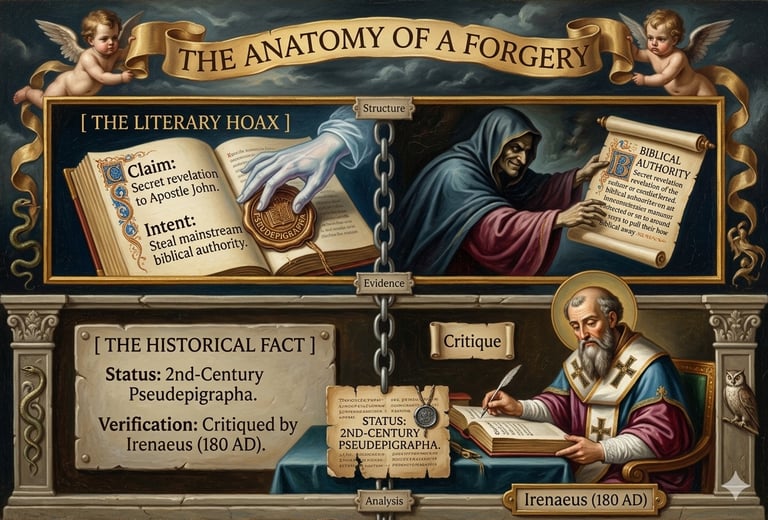
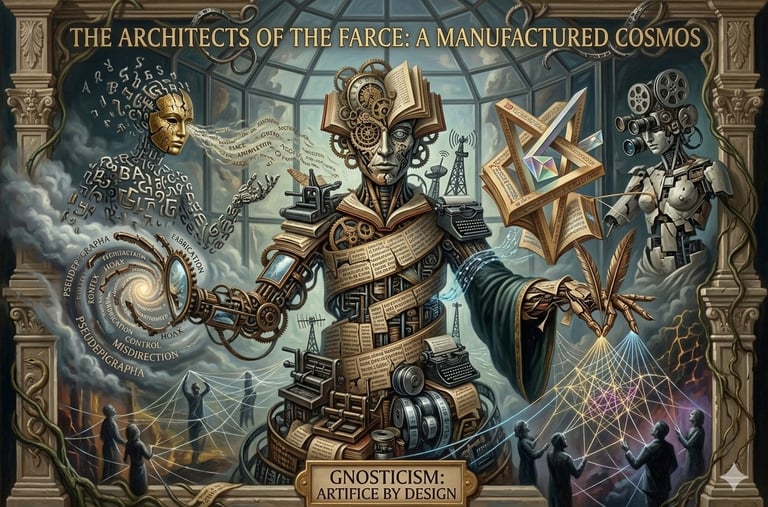
Modern biblical scholars, historians, and linguists broadly classify The Apocryphon of John as a work of pseudepigrapha—a common literary practice in the ancient Mediterranean world where an anonymous author deliberately attached the name of a famous, revered historical figure to their own writing. The intent behind this move was simple: instant theological clout.
By framing these radical, inverted ideas as a "secret revelation" delivered by the resurrected Christ to the Apostle John on the Mount of Olives, the true, anonymous author sought to bypass the defensive walls of early Christian communities. It was a literary Trojan horse designed to steal apostolic authority and trick early believers into accepting a worldview completely alien to the Hebrew Scriptures.
Scholars have definitively traced the composition of this text to an anonymous, highly educated Gnostic philosopher writing in the early second century. We know with absolute historical certainty that the text was circulating well before 180 AD, precisely because the early Church Father St. Irenaeus of Lyons had a copy of it on his desk and heavily criticized its blasphemous claims in his landmark work Against Heresies [180 AD]. The text does not belong to the biblical John; it belongs to the fragmented, rebellious intellectual movements of the second-century Roman Empire.
The Pleroma and the 30 Aeons
Within the pages of this pseudepigraphal text, the origin of the cosmos is tracked back to the Monad, also called the One, the Ineffable Spirit, or the Pre-existent Father. The Monad is not a localized, personal deity who demands subservience; the Monad is defined as an infinite, incomprehensible ocean of pure spiritual light, consciousness, and unmanifested potentiality.
From the Monad’s internal self-reflection, the divine mind generates Barbelo, the first thought, the divine feminine emanation, and the ultimate womb of the spiritual universe. Through a harmonic cascade of pristine consciousness, Barbelo and the Monad bring forth Autogenes, the Anointed Divine Son. This core spiritual Trinity forms the apex of The Pleroma (the Fullness)—the eternal, uncreated realm of absolute spiritual reality.
The Pleroma is organized as a perfect multidimensional clockwork consisting of exactly 30 Aeons (eternal spirits or divine expressions), collectively known as The Triacontad. These 30 Aeons exist in perfect balance, arranged in syzygies—divine male-female pairings that mirror the polarities of the Monad’s consciousness.
To govern this majestic realm of light, the Divine Son emanates Four Great Luminaries: Harmozel, Oroiael, Daveithai, and Eleleth. Each of these Four Luminaries acts as a spiritual beacon, and each brings forth three distinct Sub-Aeons, or divine virtues, to exist alongside them, completing a perfect array of twelve virtues. Under the fourth and final Luminary, Eleleth, sits the absolute youngest, lowest, and outermost Sub-Aeon of the Pleroma: Sophia (Wisdom). Because Sophia is stationed at the very fringe of the light realm, bordering the terrifying expanse of the uncreated lower chaos, she is uniquely vulnerable to the catastrophic error that would shatter the divine order.
The true institutional death blow to Gnosticism came in the fourth century through imperial and ecclesiastical stabilization.
When Emperor Constantine legalized Christianity in 313 AD, he favored the disciplined, highly structured network of the orthodox Church to help unify his fractured empire over the chaotic, unpredictable Gnostic groups.
The definitive turning point occurred in 367 AD, when Athanasius, the Bishop of Alexandria, issued his famous strict Festal Letter. For the first time, Athanasius listed the exact 27 books that made up the official New Testament canon, explicitly ordering Christian communities to reject and destroy all apocryphal, heretical, and "secret" texts.
Faced with the immediate threat of their library being confiscated and burned by imperial authorities, a group of Gnostic-leaning monks at a nearby Pachomian monastery took drastic action. They gathered their precious collection of alternative scriptures—including The Apocryphon of John and The Hypostasis of the Archons—and packed them carefully into a heavy earthenware jar . They climbed the nearby desert cliff of Nag Hammadi and buried the jar deep in the dry Egyptian soil.
By driving these ideas deep into the earth, they created an accidental chronological time capsule. It successfully bypassed 1,600 years of institutional censorship, waiting for the swing of a shovel in 1945 to reopen the cosmic debate.
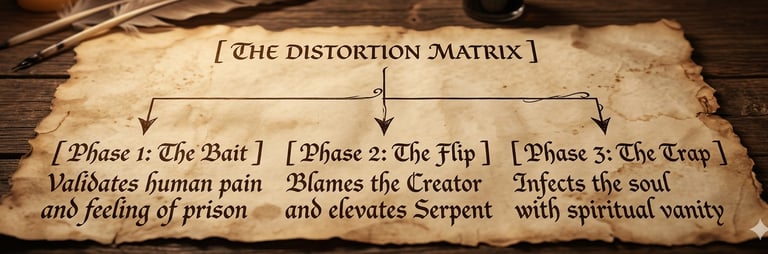
Phase 1: The Bait (Weaponizing Human Suffering)
The unchained host targets humans at their absolute weakest points: the moments of intense personal grief, physical pain, and trauma that naturally occur within our earthly training ground. When a human soul undergoes a sudden tragedy, a terminal illness, or the crushing weight of systemic injustice, the fallen entities intercept that pain.
They approach the suffering seeker and whisper a highly calculated, empathetic validation: "You are entirely right to feel out of place here. Look around you—the sickness, the decay, the cruelty. This entire world is a rigged simulation, a prison cell. A truly loving God could never be the author of this nightmare."
By agreeing with the human intuition that the earth feels like a cage, the fallen angels instantly win the seeker’s trust. They pose as the only honest librarians in the universe, pretending to expose the hidden mechanics of the matrix to help humanity break free.
Phase 2: The Flip (Cosmic Projection and Deflection)
Once the seeker's defensive walls are down, the fallen angels execute the master stroke of the psy-op: a massive act of cosmic blame-shifting. They take their own worst psychological traits—their blinding pride, their fierce jealousy of humanity's potential, their obsession with totalitarian control, and their eternal desire to usurp the throne—and project them entirely onto the Creator God.
By rebranding the benevolent, refining Father of life as the monstrous, beast-faced "Yaldabaoth," the fallen forces accomplish a staggering act of spiritual sabotage. They convince the human seeker that the Source of all light is actually a blind, narcissistic tyrant. This ensures that the human will actively flee from the only God capable of saving them, running straight into the arms of the enemy out of fear and disgust.
Concurrently, they rebrand their own identity. The Serpent in the Garden—the very fallen agent that initiated the fracture of humanity—is recast as a heroic, enlightened liberator bringing gnosis to Adam and Eve. The unchained host reframes their original ancient mutiny against God as a righteous act of intellectual evolution, tricking humans into joining Satan's army under the guise of fighting for spiritual freedom and cosmic enlightenment.
Phase 3: The Trap (The Infection of Spiritual Vanity)
The final lock on this conscription trap is the concept of gnosis itself. By telling a select group of humans that they possess a special, hidden knowledge that makes them naturally superior to ordinary believers, the distortion infects the human soul with the exact same spiritual cancer that caused the angels to fall in the first place: pride.
This is exactly where the trap becomes highly practical and dangerous. When we begin to see through the blatant institutional machinations running our world—whether it is the corporate pressure to take Ozempic-style medications that fit idealized stereotypes at the cost of our bone health, the rollout of unproven vaccines fueled by fear-baiting, or the environmental assault on our creative centers through glyphosate, fluoridated water, 5G infrastructure, and atmospheric sprayings—the unchained host springs their trap. They weaponize our valid awareness to breed cynicism. They trick us into looking down on our fellow countrymen as mere "sheep" who are going to get what they deserve, causing us to abandon our brethren to protect our own "enlightened" status.
This "save yourself" survivalist mentality is the exact polar opposite of Christ's example. It isolates the seeker in a closed psychological loop. The Gnostic or New Age practitioner begins to look inward, worshiping their own intellect and elite "awakened" status, completely insulated from the universal concepts of humility, repentance, and unconditional grace. They stop seeking the Father and begin seeking the self.
This isolation is further protected by heavy cultural programming designed to keep our psyche from encountering pure, authentic, creative revelations from the Most High. Think back to the heavy, melancholic media campaigns of the late 20th century—epitomized by the "there is no hope" 1990s lullabies like Lauryn Hill singing Nothing Even Matters—which conditioned an entire generation to accept spiritual apathy. It is a system designed to make you look at the fallen angel instead of the Most High, throwing up your hands in despair and losing your joy.
The Tragic Paradox of the Conscription
In this light, the Gnostic texts become the ultimate tragic paradox. The elaborate star maps, the 30 Aeons, the beast-faced Archons, and the secret passphrases aren't keys to escape the prison cell. They are the interior decorations of the cage, engineered by the unchained host to keep the inmates intellectually entertained and endlessly debating the mechanics of the simulation.
While the human seeker thinks they are learning the secret codes to beat the matrix, they are actually being systematically trained to think, act, and rebel exactly like a fallen angel. They are being prepped to march in Satan's counter-army, completely oblivious to the fact that the only true exit door—the simple, humble surrender to the true Creator—is the one door they have been conditioned to despise.
The Covert Operation: The Savior’s Disguised Descent
Because the twelve Archons aggressively guarded the planetary gateways of the seven heavens, an open rescue mission by the true supreme Monad was a structural impossibility. If the unmitigated, blinding light of the true Father entered the material matrix openly, the Archons would detect the intrusion immediately. In their panic, they would lock down the celestial spheres, plunge human consciousness into deep spiritual amnesia, and tighten the loops of astrological fate.
Satan's Short Season
The Book of Revelation further describes Satan being bound for a thousand years before his eventual release for a final "short season" of intensified deception prior to the last judgment. Taken together, these texts paint a picture of a persistent and organized spiritual opposition to the Creator, one that operates not primarily through brute force, but through deception, counterfeit wisdom, forbidden knowledge, and the corruption of human consciousness.
If the Gnostic texts are viewed through this lens, their message begins to take on a very different character. The promise of secret enlightenment, the elevation of hidden knowledge above simple faith, the inversion of God's role from Creator to jailer, and the glorification of rebellion against divine authority all bear a resemblance to the very temptations that these ancient traditions repeatedly associate with the fallen ones.
We could be living in the shadow of that unchaining during these times. While many feel the fallen host have been granted access to the material plane to test the spiritual frequencies of human beings who are currently navigating the intense, painful hardships of the earthly school, some believe we're meant to test them back.
Their strategy during this short season appears to have shifted into a desperate, massive conscription campaign. They are roaming the earth to build a counter-army out of human souls, and they are using the modernized tenets of their old farce, Gnosticism as the premier recruitment tool.
The Great Subversion: Rebranding God and the Host
With the structural walls of the material prison securely locked into place, Yaldabaoth and his twelve Archons had to solve a critical logistical problem: how to prevent the human souls trapped inside these fleshly containers from ever looking past the celestial ceiling. If humanity discovered that their inner spirits were actually fragments of a higher divine spark originating from the infinite light of the Pleroma, they would immediately revolt against their captors. The solution was a massive act of cosmic identity theft. The Gnostics asserted that the Demiurge did not merely rule through raw force; he ruled through a systematic, multi-layered campaign of disinformation that flipped the spiritual vocabulary of the cosmos completely upside down.
The Error of Sophia and the Birth of Chaos
The cataclysm that birthed the Gnostic's physical universe begins with a solitary, rogue movement of Sophia’s mind. Fascinated by her own inherited creative capacity, Sophia experiences an independent desire to bring forth an emanation of her own, entirely separate from the divine collective. Crucially, she acts without the consent of the supreme Monad, and she refuses to collaborate with her male spiritual partner.
Because her creative act is isolated from the full, balancing harmony of the Pleroma’s male-female pairs, the thought fractures as it leaves her mind. The product of her independent womb is not a perfect spirit of light, but a terrifying, malformed abnormality. The Apocryphon of John captures the absolute horror of this cosmic birth:
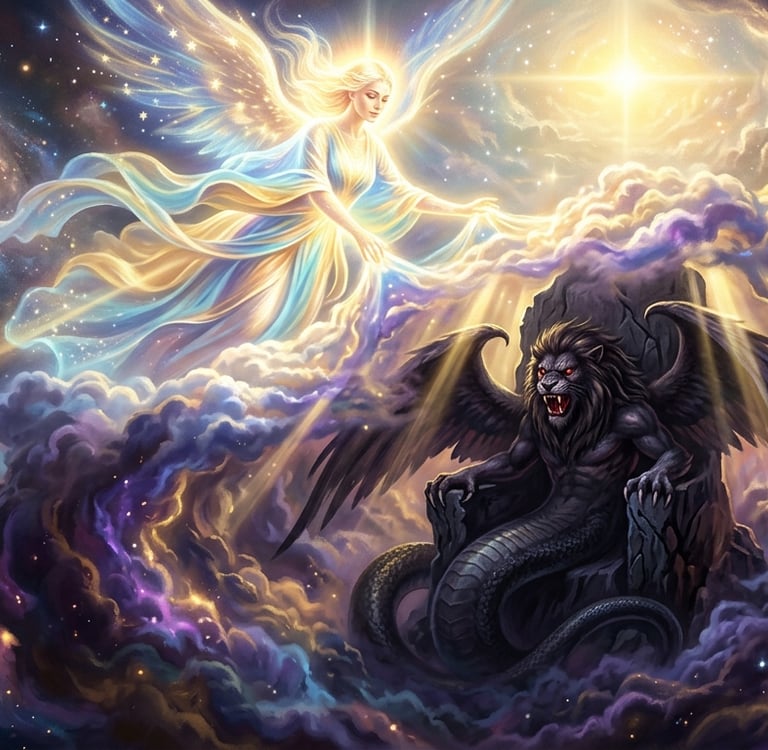
"And because of the unconquerable power which is in her, her thought did not remain idle, and something came out of her which was imperfect and different from her appearance, because she had created it without her consort... And when she saw her desire, it changed into a form of a lion-faced serpent. And its eyes were like flashing fires of lightning. She cast it away from her, outside of those places, so that none of the immortal ones might see it, for she had created it in ignorance."
Overwhelmed with shame, guilt, and terror at what she had produced, Sophia attempts to hide the monster from the rest of the eternal Aeons. She casts the lion-faced serpent completely out of the Pleroma, veiling him inside a thick, luminous cloud of dense darkness situated in the lower chaos.
The Rise of Yaldabaoth
The creature hidden within the cloud is Yaldabaoth, the Demiurge (the "Public Worker" or Craftsman). Left alone in the dense, dark vacuum of chaos, Yaldabaoth is born into absolute spiritual blindness. Because he is trapped beneath the opaque cloud created by his mother, he is completely oblivious to the higher realms of uncreated light. Looking out into the empty, black void, he sees nothing but his own presence.
However, Yaldabaoth is not entirely empty; when he was cast out, he absorbed a vast portion of the divine light-power that resided within his mother, Sophia. Using this stolen spiritual energy, he begins to manipulate and shape the raw, chaotic matter around him. Mistaking his isolation for supremacy, Yaldabaoth arrives at the ultimate delusion: he believes himself to be the absolute, first-cause creator of all things, and he begins to engineer a physical universe to serve as his personal kingdom, setting up the construction of the 12 Archons.


When this vanity is contrasted against the core tenets of historical fellowship, the cynical Gnostic narrative dissolves. In this grounded frame of mind, humanity is not under the control of an unhinged, malicious tyrant. Reality is governed by a compassionate Creator who does not wish to see people upset, angry, or paralyzed by panic. It centers on a sovereign, just God, but with a highly specific boundary: justice is a divine weight, not a human weapon. Spiritual strength means surrendering thoughts of earthly vengeance, laying down the burden of chronic anger, and relying entirely on Grace to balance the scales of life; just as it has always done anyway.
To ensure the human mind never walks into this trap of anxiety, a profound, unshakeable reality echoes throughout scripture: the overarching command to "Do Not Fear" serves as a continuous daily shield. Across the text, direct variations of this blessing—such as "fear not" and "be not afraid"—appear well over a hundred times. This massive volume of reassuring declarations stands as an unmistakable wall of defense for the human spirit, exposing the fact that we are not under the control of an unhinged tyrant, but a loving Creator who does not wish to see us upset, angry, or afraid.
While there may be angels in this realm whose idea of a good time is watching the human soul writhe in forgetfulness, cut off from Source, scared, nervous, and reactive—entities who have invented an entire perversion of the realm of the Most High—there are believers who have been shielded from these corruptions. These are seekers who have cultivated a steady relationship based on trusting that they are exactly as they need to be, made by a Creator who is perfect, and not a monstrosity, who allows us free will to strengthen ourselves spiritually and practice discernment during these times.
This dynamic of spiritual defense mirrors the rare 1749 manuscript, The Last Speech of John Good, where the ultimate weapon granted by the Creator to the Prince Vizier to guard against the tyrannical Giants of the Sethite line was not a blade of anger, but the scorpion of Conscience—a tool designed to sting prideful entities back into re-encountering their lost humility.
This opens up the profound possibility that before ever stepping foot onto this plane, a soul decides exactly which issues, tragedies, and systemic deceptions it will encounter in this lifetime. These specific trials are chosen not as a punishment, but to see if our spiritual strength can be voluntarily evolved under pressure. Look around today, and you will see that we are indeed surrounded by an abundance of trials, institutional machinations, and tribulations. But if this existence is truly a school designed to train ourselves to love in the midst of absolute hate—to openly offer help, gifts, gratitude, and clear guidance in the face of intense fear-mongering and a pervasive scarcity mindset—then humanity has not been dropped into a prison by accident. We have arrived onto this earthly plane at the exact right time.
True freedom is not found in the isolating vanity of gnosis, but in a radical, self-sacrificing compassion that echoes the template laid down by Christ: "There is no greater love than that of laying down oneself for a friend." Life isn't about possessing all the facts or knowing all the answers beforehand; it's about having faith the answers we seek will be revealed in good time, the journey of discovery and what we do with the knowing once it's realized.
The ancient Gnostics thought they had to memorize secret passphrases and navigate a terrifying celestial checkpoint to escape. But classical mysticism and the true Gospel expose that as the ultimate distraction. The matrix of deception may real, but the source code of the scripture teaches that there is only one true exit door, and it is opened with the keys of humility, love, and surrender to the will of the Most High.
Comprehensive Source Material Index
Sethian Gnostic Texts (Nag Hammadi Library):
The Apocryphon of John (The architecture of the Pleroma, the 30 Aeons, the birth of Yaldabaoth, and the 12 Archons).
The Hypostasis of the Archons (The blind boast of Samael, the rebranding of the Eden narrative, and the Savior's role).
The First Apocalypse of James (The post-resurrection passphrases used to bypass the planetary toll collectors).
Pistis Sophia (The post-resurrection cosmic ascent of Christ, the disruption of the zodiac, and the role of lower archangels).
Patristic Refutations:
St. Irenaeus of Lyons, Against Heresies, Book III & IV, c. 180 AD.
Classic Texts:
Brooke, Henry. The Last Speech of John Good, 1749.
Modern Texts:
Orlov, Andrei A. The Watchers of Satanail: The Fallen Angels Traditions in 2 (Slavonic) Enoch. Milwaukee, WI: Marquette University Department of Theology. https://www.marquette.edu/maqom/watch55.html.
Abrams, Michael. The Evolution Angel: An Emergency Physician's Lessons with Death and the Divine. Abundance Media, 2000.


This massive public roasting severely bruised Simon's immense ego. Driven by wounded pride and an inability to stop the momentum of the true Church, Simon Magus retreated from fellowship and spent the rest of his life engineering a highly calculated, vengeful retaliation. He realized he could not defeat the Gospel through simple magic tricks, so he set out to create the original prototype of the Gnostic inversion, intentionally rewriting the celestial hierarchy.
Early Church historians like St. Irenaeus of Lyons, who wrote Against Heresies, c. 180 AD, verify that Simon began traveling the Roman Empire preaching that he himself was actually the supreme Father manifested as a phantom, and that the lower angels running the visible world were incompetent usurpers who had trapped human consciousness in a material grid.
Simon passed this rebellious template down to his disciple Menander, who passed it to Basilides, eventually forming the multi-layered lineage that produced the anonymous pseudepigraphal library of the second century. He was the original magician who, after being denied a seat at the table, sought to flip the table entirely by rebranding the Creator as a tyrant.
The Lineage of the Mutiny
The spiteful blueprint engineered by Simon Magus did not vanish with his death; it evolved through a direct, generational relay of highly educated disciples who transformed raw Samaritan sorcery into a complex, pseudo-Christian network across the Roman Empire.
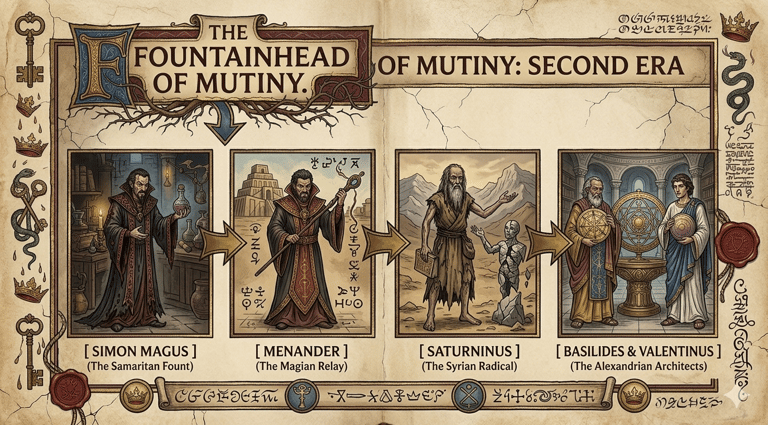
Simon passed his rebellious matrix template down to his personal disciple, Menander, another Samaritan magus who moved the operations to Antioch. Menander stripped away Simon’s overt self-deification and began framing the system as a cosmic "rescue mission" from the planetary angels who built the world. It was under Menander’s tutelage that the true structural architects of the second-century library were trained: Saturninus and Basilides.
The Syrian Extremism of Saturninus
Operating in Antioch around 100–120 AD, Saturninus became the missing evolutionary link by executing a stunning rhetorical pivot: he became the first to weave Jesus Christ into the Gnostic grid. However, Saturninus’s universe was bleak, raw, and aggressively anti-material.
He preached that the physical world was a total disaster built by a low company of seven planetary angels—one of whom was the God of Israel. In Saturninus’s literature, humanity was originally crafted by these weak angels as a pathetic creature that could only wriggle on the mud like a worm, until the Supreme Father took pity and dropped a glowing spark of life into it to make it stand upright.
To escape this physical cage, Saturninus pioneered Docetism (proclaiming Jesus was a bodiless spiritual hologram who only seemed to have real flesh) and commanded his followers to strictly abstain from marriage, sex, and meat, branding physical reproduction as a trap invented by Satan to capture more divine sparks.
The Alexandrian Metamorphosis: Basilides and Valentinus
While Saturninus’s dualism was fierce and abrasive, his contemporary Basilides took the same foundation to Alexandria, Egypt, and turned it into an elite astronomical science. Basilides expanded the architecture of the cosmic cage into a dizzying hierarchy of 365 stacked layers of heavens, all governed by a monstrous, snake-legged cosmic ruler named Abraxas. Basilides was a literary titan, writing a massive 24-book commentary on the Gospels—but he also popularized the ultimate historical "switcheroo," claiming that Jesus swapped faces with Simon of Cyrene on the road to the cross, leaving Simon to be mistakenly crucified while Jesus stood safely in the crowd, laughing at the ignorance of the Roman executioners.
Finally, the evolutionary trajectory reached its absolute intellectual and literary zenith in Valentinus (c. 100–160 AD). Valentinus moved to Rome and nearly became the Pope, losing the election by a razor-thin margin. Valentinus realized that raw anti-material hatred would not win over the Roman elite, so he completely repackaged Gnosticism into smooth, beautiful, and deeply seductive psychological allegory.
Valentinus didn’t paint the Creator God as a slavering, evil beast; he painted him as the Demiurge—a tragic, blind craftsman who was simply ignorant of the higher realms and doing his best to run a cosmic incubator. Through beautifully poetic masterpieces like The Gospel of Truth, Valentinus argued that the material world was not a malicious dungeon, but a collective nightmare born of spiritual amnesia.
It was this dizzying, multi-layered lineage—stretching from the wounded pride of Simon Magus, through the severe cosmic dualism of Saturninus, to the brilliant, allegorical psychology of Valentinus—that ultimately synthesized the grand cosmic mythos. And the definitive, highly weaponized textbook where all of these independent threads finally converged into a single, comprehensive manual was the ultimate theological counterfeit of the second century.
The Trojan Horse of the Second Century
The primary roadmap used by gnostics to navigate Simon's realm is titled The Apocryphon of John (The Secret Book of John), which was pulled from the Egyptian sands in 1945 as part of the Nag Hammadi library discovery.
Before analyzing its complex, cinematic cosmology, a critical historical correction must be established to protect the integrity of biblical history: the historical Apostle John did not write this book.

Contact
Questions or feedback? Reach out.
shift@searchinghistoryforthem.com
AI/ECO: This website uses AI for good.
Our host uses 100% renewable-powered servers and advanced cooling systems.